Edinburgh buses are run almost entirely by Lothian Buses — Britain’s largest municipally owned bus operator, owned by the City of Edinburgh Council. With more than 70 routes, a fleet of nearly 700 vehicles, the Edinburgh Trams network alongside it, and a flat £2 single fare on every standard service, Lothian gets you around the capital faster, cheaper and more reliably than any other UK city outside London. This guide covers everything you need to know: the headline routes, ticket types, the Transport for Edinburgh app, night buses, accessibility, Edinburgh Trams, and the small etiquette details (yes, locals say thanks to the driver) that make using the network feel native.
Lothian Buses at a Glance
Lothian Buses is Edinburgh’s primary public transport operator. The fleet is overwhelmingly modern (one of the youngest in the UK, with a third of buses introduced since 2024), the routes are dense (most of the city is within a five-minute walk of a stop), and the frequency is generous (every 7–10 minutes on busy corridors all day). The company also runs Lothian Country, Edinburgh Coach Lines, Edinburgh Bus Tours, and — through the Transport for Edinburgh umbrella — Edinburgh Trams.
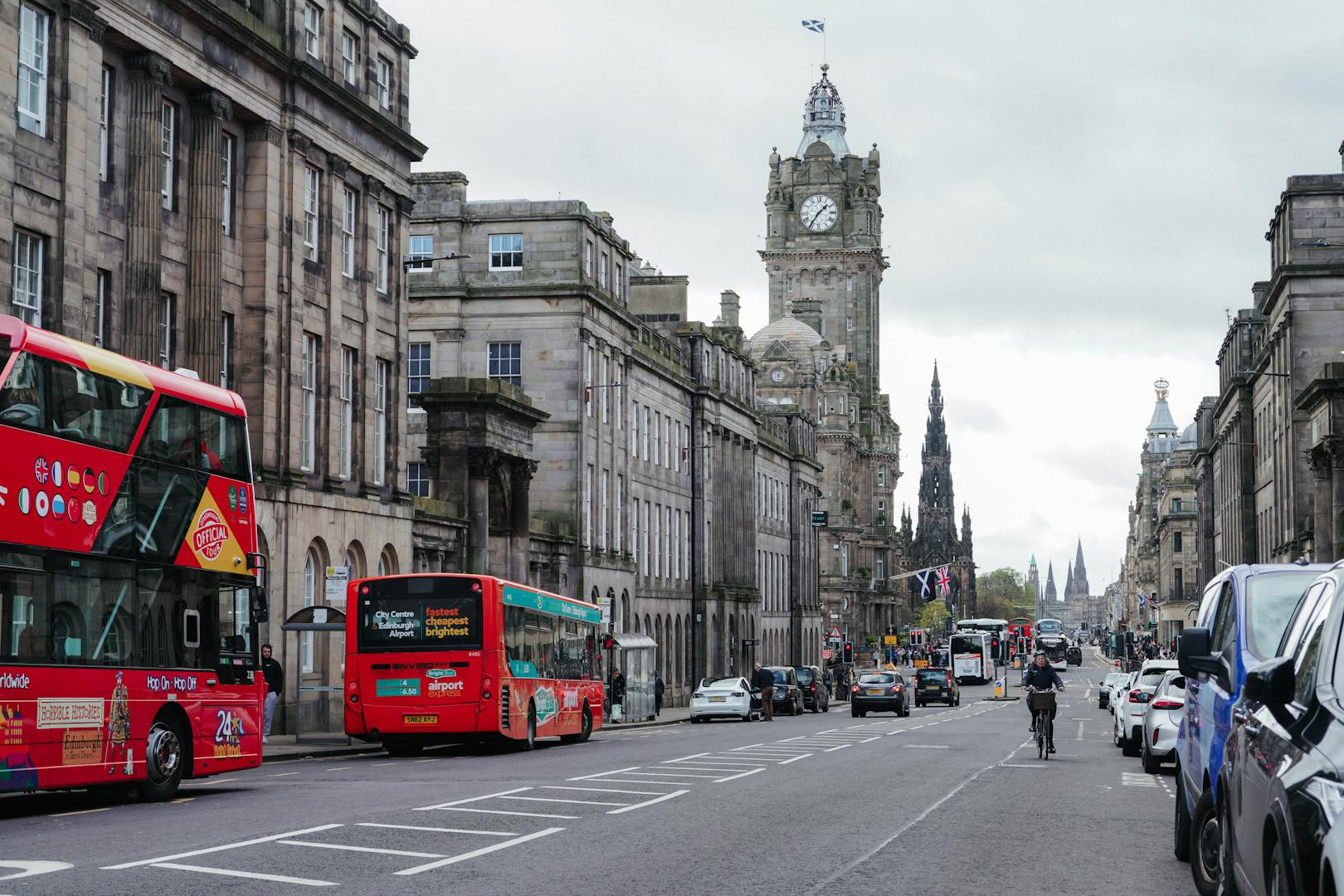
Every Lothian bus is double-deck, except a small handful of single-deck Midi vehicles on rural routes and the East Coast Buses (a Lothian subsidiary) that connect the city to North Berwick, Haddington and the East Lothian coast. The fleet is bright red and white, instantly recognisable, and every stop has live real-time arrival information either on a digital pole-mounted sign or in the Transport for Edinburgh app.
The Flat £2 Fare and Daily Cap
The single most important thing to understand about Edinburgh buses Lothian is that the standard adult single fare is £2. It does not matter whether you travel one stop or all 28 stops along Route 22 from Ocean Terminal to Gyle Centre — £2 covers it. The child fare (ages 5–15) is £1.30. Children under 5 travel free.
You pay either with cash (exact change only — Lothian drivers do not carry change), with contactless tap-on at the front of the bus, or via a saved ticket in the Transport for Edinburgh app. Contactless is the fastest, and it is also the cleverest, because it triggers Lothian’s Tap & Go daily cap: tap the same card all day and you will never pay more than the equivalent day-ticket price (£5.00 adult, £2.60 child). This means casual visitors are automatically charged the cheapest fare without needing to predict their journeys.
The Tap & Go cap also extends across modes — buses and trams share a cap when you tap on with the same card. If you take an Airlink airport bus (single £5.50) and then start hopping on local buses, the system will keep counting until you hit the airport-inclusive day cap of £10.50.
Ticket Types Beyond the Single
Most visitors will only ever use single fares and contactless tap-on. But if you are staying a few days, or you are travelling as a family, here are the options worth knowing.
Dayticket
The Lothian Dayticket gives unlimited travel on Lothian Buses (not including Airlink, tram or Skylink routes 200/300/400) for £5.00 adult, £2.60 child, or £10 for a family of two adults and three children. It is bought on the bus, in the app, or from the Lothian Travelshops on Hanover Street and Waverley Bridge. The Dayticket starts when you first use it and expires at the end of the calendar day.
Day Ridacard / Tram and Bus Day Ticket
For £8.50 (adult), the Day Ridacard adds the tram into the mix — unlimited tram and bus travel within the city zone. Add £2 for the airport extension. This is the right pick if you are planning to bounce between the airport tram, a Castle visit, and a Leith dinner.
Edinburgh Family Ticket
Two adults plus up to three children for £10 a day on all Lothian Buses. A genuine bargain if you are visiting with family — it covers everything from a morning trip to Edinburgh Zoo to an evening run to Portobello.
Ridacard
Lothian’s monthly travelcard. A four-week adult Ridacard is £63, a one-week Ridacard is £20, and an annual Ridacard is £660. Useful for longer-stay visitors or anyone studying in the city. Bought from Travelshops or online.
Senior and Young Persons Cards
Scottish residents over 60 and under 22 travel free across all Lothian Buses with the national Young Scot or NEC card. Disabled passengers with a Scottish NEC also travel free. International visitors do not qualify.
The Transport for Edinburgh App
The free Transport for Edinburgh app — also branded “Lothian Buses” in older versions — is the single best tool for navigating the city. Download it before you fly. It does five things brilliantly:
- Live arrival times for every bus and tram at every stop, with real-time tracking on a map.
- Journey planner across bus, tram and walking modes, with realistic walk-from-stop calculations.
- Mobile tickets — purchase Dayticket, Family, Airlink or single fares in advance.
- Fare cap visibility — you can see what you have spent today and what the cap will charge.
- Service alerts — diversions during marathons, parades, festival processions and (in winter) snow disruption.
Edinburgh Trams: Same Network, Different Carriage
Edinburgh Trams is the city’s only light rail line — a single route running from Edinburgh Airport in the west, through Murrayfield, Haymarket, Princes Street, St Andrew Square, Picardy Place, Leith Walk, Foot of the Walk, The Shore and on to Newhaven. The Newhaven extension opened in June 2023 and added the most useful section of the line for visitors — Princes Street, St Andrew Square and Leith are now stitched together with a five-to-ten-minute headway service.
Tram tickets are integrated with the bus network: a £8.50 day pass covers both, and the Tap & Go cap applies across modes. Single fares on the tram are £2 within the city zone (£8.50 if including airport zone). Trams come every 7–10 minutes during the day, with the first service from the airport around 06:18 and the last around 22:48.
The tram is the smoothest ride in the city — fully step-free, ultra-quiet, and totally segregated from road traffic on most of its length, which means it is not affected by Princes Street congestion. If you are staying anywhere along the line, use it for journeys that would otherwise involve walking a long stretch of Princes Street or Leith Walk.
The Most Useful Lothian Bus Routes for Visitors
Locals know the routes by number; visitors can pick them up surprisingly quickly. Here are the routes that come up again and again in itineraries.
Route 22 — Ocean Terminal to Gyle Centre via Princes Street
The 22 runs every 5–7 minutes and is the spine of north–south central travel. It calls at Leith, Bernard Street, McDonald Road, York Place, Princes Street, Haymarket, Murrayfield, Saughton and the Gyle. If you are staying in Leith and want to get to the centre, the 22 is the answer.
Route 35 — Ocean Terminal to Riccarton via Royal Mile
The only Lothian route that runs along the Royal Mile itself (most others use parallel streets). It is a useful one for getting from Leith to Holyrood Palace, the Scottish Parliament, and down to Heriot-Watt University.
Routes 23, 27, 45 and 47 — South Side and Marchmont
These four routes serve the southern parts of the city — Bruntsfield, Marchmont, Newington, Morningside and beyond. If you are staying in a south-side B&B, you will likely use one of them.
Route 11 — Princes Street to Hyvots Bank via Cameron Toll
Runs along Lothian Road, through Tollcross, past the Meadows, and out to the south of the city. Useful for King’s Theatre and EICC visits.
Route 1 — Easter Drylaw to The Jewel via West End
The longest route on the network, crossing nearly the entire city from north-west to south-east. Useful for connecting Stockbridge with Princes Street and the Eastern New Town.
Route 19 / 19a — Granton to Lasswade via Royal Botanic Garden
The 19 family stops at the Botanic Garden gate and continues north to Granton (where the new neighbourhood is rapidly developing) and south to Lasswade. Tourists most commonly use it to reach the Botanic Garden.
Route 26 — Clermiston to Tranent via Princes Street
An east–west spine through Corstorphine and Edinburgh Zoo, calling at Princes Street, the Royal Mile (Cannongate), Meadowbank and out to East Lothian.
Route X44 — Edinburgh to Penicuik
One of the express routes useful for day-trippers heading south, including those bound for Roslin Glen or Dalkeith Country Park.
Routes X5 and X25 — Edinburgh to Linlithgow and Stirling
For day trips into West Lothian and Stirling. Operated by Lothian Country, a Lothian subsidiary.
Edinburgh Bus Tours: The Hop-On Hop-Off Network
Edinburgh Bus Tours, Lothian’s sightseeing division, runs three open-top routes from Waverley Bridge. The City Sightseeing (red) covers the classic loop around the New Town, Old Town and Holyrood. The Edinburgh Tour (yellow) follows a similar but slightly different route with a different commentary. The Majestic Tour heads further afield — to the Royal Botanic Garden, the Royal Yacht Britannia and the western edges. A 24-hour ticket on a single tour is £20 adult, £8 child; a 48-hour ticket covering all three is £30 adult, £15 child. Useful for first-time visitors who want an overview before exploring on foot.
Night Buses
Edinburgh’s night bus network runs 00:00–04:30 on Friday and Saturday nights (and some routes seven days a week). The principal routes are N1, N3, N7, N11, N14, N16, N22, N26, N31 and N34 — broadly the same numbers as the daytime equivalents. They radiate out from St Andrew Square and Princes Street. The night fare is £4.30 single, double the daytime rate. Buses depart roughly every 30–60 minutes through the night. Tap & Go applies. The Airlink 100 runs 24-hour at standard frequency, so for airport-bound late departures it is usually the more reliable choice than a Night Bus connection.
How to Find a Bus Stop
Edinburgh’s bus stops are clearly marked with a red flag pole and a real-time arrival sign at most stops. Each pole displays the routes that serve it, the route map, and the timetable. There is no need to flag the bus down on most central routes — drivers stop at every signed stop unless the bus is full. On rural routes where stops are less frequent (notably in East Lothian and Midlothian), it is polite to put your hand out as the bus approaches.
The Transport for Edinburgh app shows every stop on a map with live arrivals; you can also search by stop code (a four-digit number on the pole sign). For real-time tracking, the most popular third-party app among Edinburgh locals is Citymapper, which integrates Lothian’s open data feed.
Boarding, Paying and Etiquette
Lothian buses are boarded at the front door. The driver controls the doors; do not try to use them yourself. Tap your contactless card on the reader (or insert exact-change cash into the slot beside the driver, or show your mobile ticket). The driver does not need to see most passes — the contactless reader will beep green when you have tapped successfully.
The most distinctively Edinburgh moment of any visit is the universal habit of saying “thanks driver” as you alight. The driver press is acknowledged by everyone from schoolchildren to executives. Pressing the red Stop button on the handrails about 50 metres before your stop is enough — drivers will not stop without a request between two designated boarding-stops.
Accessibility on Lothian Buses
Every Lothian bus is fully wheelchair-accessible, with low-floor entry at the front door, an extending ramp deployed by the driver, and a dedicated wheelchair space in the saloon. There is also room for one or two unfolded pushchairs per vehicle. Audio announcements call out every stop. Hearing-loop induction is standard. Companion Cards (which allow a carer to travel free with a paying passenger) are accepted.
For visitors with mobility needs, the tram is even more accessible — level boarding at every stop with no need to extend a ramp. The Transport for Edinburgh app includes step-free filtering for journey planning.
The Tour Buses, Open-Tops and Vintage Fleet
Beyond the everyday red double-deckers, Lothian operates a small fleet of vintage and special-purpose buses for events. The Heritage Tour, Edinburgh Tour open-top fleet, and the occasional vintage Routemaster appear during the Fringe and Hogmanay. The Lothian Country buses to East Lothian beaches are sometimes open-top in summer, which makes the coastal section of the journey to North Berwick a small pleasure.
Connecting With Trains, Trams and the Airport
Most Lothian routes call at Princes Street or St Andrew Square, which are both within 200 m of Edinburgh Waverley railway station. For Haymarket Station, take routes 12, 26 or the tram. For Edinburgh Airport, use the dedicated Airlink 100 from Waverley Bridge (24-hour service, £5.50 single), the cheaper Skylink 200/300/400 routes from various western suburbs, or the tram from anywhere along the line. See our dedicated Edinburgh Airport to City Centre guide for a deep dive on airport transfers.
Bus Travel Beyond Edinburgh: Lothian Country and East Coast Buses
Two Lothian subsidiaries extend the network into the surrounding counties. Lothian Country serves Linlithgow, South Queensferry, Bo’ness and Penicuik; tickets and Tap & Go cap are integrated. East Coast Buses, painted yellow, serves East Lothian — including Musselburgh, Tranent, Haddington, Dunbar and North Berwick. The famous X5 to Linlithgow Palace and X7 to North Berwick both take a little over an hour and are well-suited to day trips.
For onward travel to Glasgow, Inverness, Aberdeen, Perth and Stirling, the Citylink coach network (independent of Lothian) operates from Edinburgh Bus Station on St Andrew Square. Megabus also runs from the same station to selected UK destinations.
How Much Does a Week of Bus Travel Cost?
For a typical Edinburgh tourist using buses three times a day for five days, the cost works out at around £25 — well under most other UK cities’ equivalent. A weekly Ridacard, at £20, would cover unlimited travel for a longer stay and works out cheaper than buying daily contactless taps for a week of heavy use. For occasional use, tap-on with contactless is the simplest and the daily cap protects you from overspending.
Where to Get Help in Person
Lothian operates two Travelshops in the city centre: at Waverley Bridge (in the Lothian Buses HQ building) and on Hanover Street. They sell Ridacards, replace lost passes, advise on routes and accept cash payments. Both are open Monday to Saturday 08:30–18:00. The customer service team is also reachable by phone (0131 555 6363) and email (mail@lothianbuses.com).
Common Visitor Mistakes (and How to Avoid Them)
- Trying to pay with a £10 note: Lothian drivers do not give change. Use contactless or have exact cash.
- Assuming the bus stops at every traffic light: It only stops at marked bus stops, and only when a passenger has pressed the red Stop button or the stop has a boarding passenger.
- Confusing Skylink and Airlink: Airlink 100 is the £5.50 direct airport express; Skylink 200/300/400 are £2 local services that pass through the airport.
- Using a Dayticket on the tram: The standard Lothian Dayticket does not cover trams — you need the Day Ridacard (£8.50) for that.
- Boarding at the rear: Lothian buses are board-from-the-front only.
- Forgetting to thank the driver: Not actually a mistake, but it gives the game away that you are a visitor.
Frequently Asked Questions
How much is a bus ticket in Edinburgh?
£2 single on standard Lothian Buses, £1.30 for children 5–15, free for under-5s. The £4.30 night fare applies on Night Bus routes.
Can I use contactless on Edinburgh buses?
Yes, every Lothian bus and tram accepts tap-on with a contactless debit card or Apple/Google Pay. Tap & Go applies a daily cap automatically.
Do I need exact change for Edinburgh buses?
Yes if you pay by cash. Lothian drivers do not give change. Most visitors use contactless.
How do I find the right bus to take?
Use the Transport for Edinburgh app — search your destination and it plans the journey, shows live arrivals, and tells you the stop. Citymapper is a popular alternative.
Do night buses run in Edinburgh?
Yes, on Friday and Saturday nights primarily. Routes are N1, N3, N7, N11, N14, N16, N22, N26, N31 and N34. The Airlink 100 runs 24 hours every night.
How does the Lothian Dayticket work?
£5.00 adult, £2.60 child, valid all day on all Lothian Buses (not tram). Buy it on the bus or in the app. The tram-inclusive equivalent is the Day Ridacard at £8.50.
Is the tram included in Lothian bus tickets?
Not in the Dayticket, but it is in the Day Ridacard and is integrated in the Tap & Go cap if you use the same card across both.
Where is Edinburgh’s main bus station?
Edinburgh Bus Station is on St Andrew Square, in the New Town. It serves intercity coaches (Citylink, Megabus, FlixBus) rather than local Lothian routes, which use street stops.
Are Edinburgh buses wheelchair accessible?
Yes, every Lothian bus has low-floor entry and an extending ramp. The tram is fully step-free.
Do children travel free on Edinburgh buses?
Under-5s travel free with an accompanying adult. Children 5–15 pay £1.30 single, or the family ticket of £10/day covers two adults and three children.
Final Word: Edinburgh’s Best-Kept Public Transport Secret
Lothian Buses, alongside Edinburgh Trams, is a genuinely good story in UK public transport — a municipally owned operator running a modern fleet on a dense network at a flat £2 fare, with rare-in-the-UK levels of frequency, cleanliness and reliability. For most visitors, downloading the Transport for Edinburgh app, tapping on with a contactless card, and trusting the Tap & Go cap is all you need to do. The system does the rest. Within a day you will be navigating the city like a local — pressing the stop button half a block early, saying thanks to the driver as you step off, and quietly noting how clean and on-time everything seems to be.
For more on getting around the capital, see our companion guides to Edinburgh transport passes & tickets, walking Edinburgh and the airport-to-city-centre options. For an overview, head to our complete transport guide.